

Today I thought I’d shoot back to the other end of my zone of interest and bring you the tales of a field ambulance in the Franco-German War. I’m calling it that instead of Prussian because otherwise Jim Smithson will get a headache. The account comes from one Ferdinand Quesnoy, and was originally published in 1872. Two things are striking to me: the descriptions of wounds that could come straight out of the First World War, which show that there was nothing new about artillery domination by 1914, but also, how shockingly unready for war France was, the comparative chaos their medical personnel worked in when measured against the enemy, and the shambolic nature of their first opportunity to utilise railways in a war…
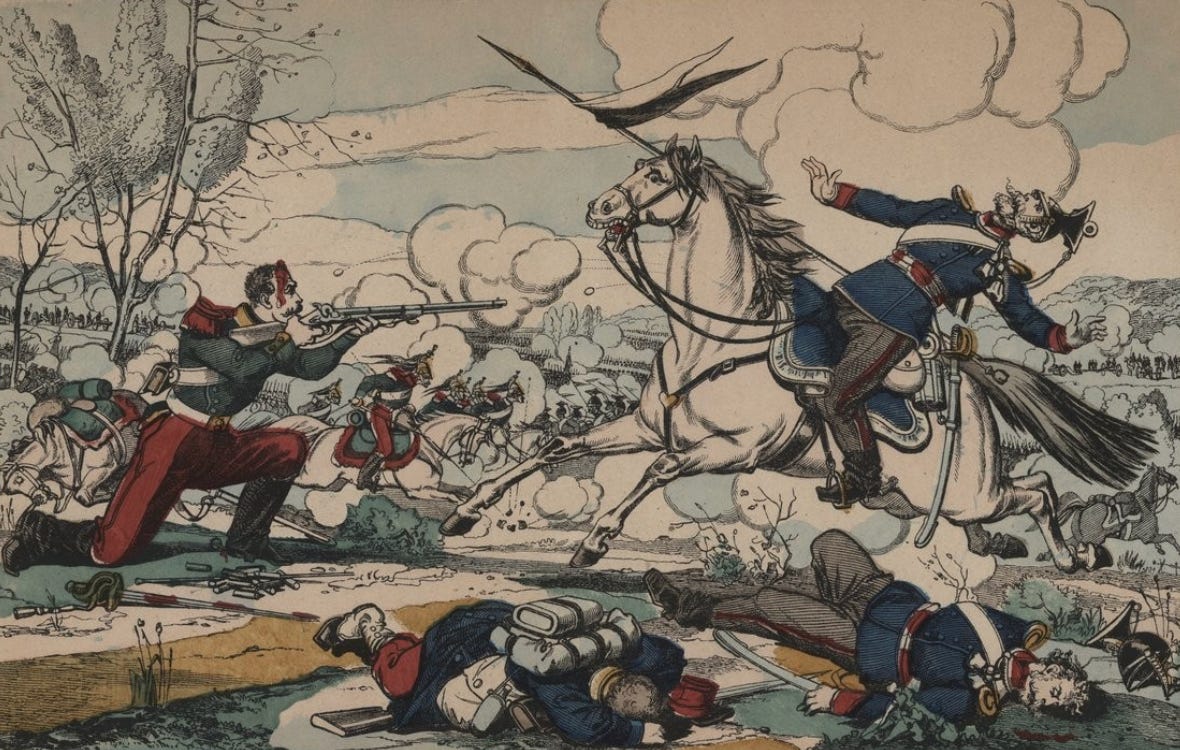
The Battle of Gravelotte, from an original periodical
After the battles and what is moving and inspiring about them, comes the painful phase where the victims are counted, collected and cared for; the role of ambulances begins, and if in the camps we hear the manifestation of joy on the day of success, whatever the result of a fight, the ambulance is always the asylum of suffering; there is opened the great book where we inscribe the price of a victory as well as that of a defeat; also in the account of battles we always neglect this saddening side, to paint only what can inspire and exalt. Why, indeed, darken the joy of a success or increase the pain of a defeat?
…Unfortunately, even at the beginning of this campaign, the regular, regulatory means were lacking everywhere, and often the ambulance itself did not exist, that is to say, there was neither personnel nor material… at the beginning of the campaign, we had such insufficient resources, and unfortunately this shortage made itself felt before we could complete ourselves. These situations do not escape the soldiers, they produce an unfortunate effect on them, give them anxiety and provoke discontent, which becomes difficult to suppress when it is justified…
I limit myself to giving the composition of the ambulances of the 6th Corps, to which I was attached. They were formed at …Châlons, with personnel recruited from all parts of France and even Algeria; there were six of them: one for each infantry division, one for the cavalry division and that of the headquarters. Each of them had as personnel: a 1st or 2nd class major physician, head of department, and three assistant majors; that of the headquarters had as head a principal physician of the 2nd class, a 1st class major physician and three assistant majors; in all twenty-six ambulance physicians for an army corps of nearly 40,000 men…
On 5th August, these ambulances received their equipment, consisting of 14 surgical carriages and 4 pharmacy carriages: two surgical carriages per ambulance and two reserves; but the teams were missing, which we only received in Metz, and all the nurses, whose number was always too limited during the campaign. They also had 20 mules of cacolets or litters, 10 Masson carriages per division, 50 stretchers, 100 blankets, 20 tents loaded on two carriages of the train, as well as a bale containing 100 shirts and 20 underpants…
in the morning, the medical personnel of the ambulance took the road to Hagueneau, where they arrived around noon, having encountered on their way only the frightened populations who were fleeing in all haste with their baggage, assuring us that the enemy occupied Hagueneau. The order was given to direct us to Reichshoflen, and we were offered the railway to transport us there. We arrived at this station at eight o’clock in the evening. It was impossible to deliver horses and carriage to us, because there were no landing platforms, no port to get off at this station; we must go to Niederbronn, where we arrive at midnight.
On 6th, at daybreak, we can move on and return to Reichshoffen where we meet the equipment and the nurses of our ambulance. Already the cannon rumbles on the side of Froschwiller, where the headquarters is located and where we feel our presence useful; the chief doctor of the ambulance goes there alone to get orders; he promptly returns to tell us that the chief doctor of the army corps is waiting for us at Froschwiller. …the quartermaster, warned of the needs that arise on the battlefield, tells us to go where our presence is required, but, called away by other cares, he forgets to give a written order to communicate to each of the constituent parts of the ambulance, and [they] refuse to march without orders from the quartermaster; the medical personnel therefore heads alone to Froschwiller.
There are already many wounded and we must act, but how and with what resources? Fortunately, we meet in the village church the deputy quartermaster of the 2nd Division, who has neither medical staff, nor nurses… but who has a box filled with dressing supplies, and it is with this resource that our improvised ambulance, which had a thousand wounded, operated. Our situation was very critical throughout the day; the shells, falling on and in the church, mutilated or killed the men entrusted to our care; the fighting sustained a few steps from us by our rearguard, the arrival of the enemy who fired on us and killed several of our wounded; the burning of the bell tower requiring a hasty evacuation, the pillaging of our surgical boxes, the music and the hurrahs of the victor, all this constituted the most tragic and most distressing scene that one can imagine. We were all nearly mistreated because we were not wearing the armband of the Geneva Convention, which no one had thought to distribute to us. During the night, the Prussians gave our wounded biscuits and broth, of which we were forced to take our share, given the absence of our provisions.
On 7th, the International Relief Society, led by M. de Flavigny, came to our aid with food and part of the relief that was so necessary to us. The scarcity of our resources was even more apparent to us the day after the battle, when we saw a German field lazaretto arrive and set up next to us, in perfect order, under the direction of a chief physician. With admirable promptness the tents were pitched, the beds prepared, the pots of broth (extracted from Liebig) and coffee placed on the fire; even ice was taken out of a special box. The German wounded were immediately removed from our hangars, who then enjoyed a well-being of which our wounded soldiers were deprived. Before our eyes, plaster bandages were applied to broken legs, while we were reduced to breaking biscuit crates to fashion the splints for our imperfect apparatus ourselves...
…Under these conditions, the ambulance personnel had only one duty, that of staying with the wounded and giving them care until the doctors of the victorious army had relieved them. This is what they did everywhere: several of our doctors remained twice in the hands of the enemy with their ambulances after our defeats and many were refused permission to return to the army invested around Metz. If the role of ambulances is easy when the armies are marching forward, when it is possible, in each centre, to create hospitals and to make evacuations to points far from the theatre of war, it becomes difficult and painful in the opposite conditions. It is at the time of a retreat that the situation becomes particularly painful, and it takes a lot of devotion and self-denial from doctors not to abandon their post at such a moment. They see the enemy flood coming with its bursts of joy and the intoxication of success; they witness the scenes of brutality and bloody violence of which our wounded have been victims several times on the part of the German soldiers; and they have had the pain of being powerless against these excesses. Nothing is spared them in this most critical condition in which an army can find itself, and they have as compensation only the consciousness of a duty accomplished.
On 16th August 16, the ambulances of the corps camped at Rézonville had bivouacked at their battlefield behind their respective divisions. At the moment when fire opened, they were pushed back a little; some established themselves in the village of Rézonville itself and occupied the church, hangars, the schoolhouse, and, as needed, they invaded the barns and even the houses; the inhabitants brought straw, a few straw mattresses and mattresses; other ambulances moved away from the village, established themselves in farms and in some shaded meadows near watercourses; the caissons were emptied in parts and only as needed, so as not to increase the difficulties in the event that a retreat would force a hasty reload; half an hour after the opening of fire, all the ambulances were able to operate and they were soon in full activity…
As in the first battles, at Rézonville we found in just as great a number these horrible mutilations produced by the fragments of the hollow projectiles; in the previous campaigns, the bullet wounds were incomparably more numerous; here they were terrible lacerations, complete ablations of limbs and very comminuted fractures; all this black, barely bleeding and presenting shapeless shreds in the torn clothing. We were no longer dealing with musketry, but with that formidable artillery which, throughout the battle, never ceased to cover our entire line with its projectiles and whose ammunition never ran out.
Wounds from shell splinters were at least two-thirds; the other third included wounds from bullets and sabre or lance blows. However, despite these great mutilations, many of the wounded still had the energy and the ability to walk to the ambulances with the help of a comrade: I saw artillerymen with a limb removed, who had just walked two kilometres, another with a horrible wound to the face who had walked the same distance. This is not to say that there is always an absence of pain; at the time of the injury, it may not exist, but it develops after the first few hours.
…As the action dragged on, the wounded piled up, and it became urgent to evacuate to Metz; the administration took the most effective measures possible, by requisitioning all the cars, unloading those of the convoy to assign them to the transport of the wounded; cacolets, litters, Masson carriages were even used for this purpose; it was regrettable, because these essential means for travel from the battlefield to the ambulances, were thus significantly reduced. Throughout the day of 16th, during the night, we directed to Metz as many of our wounded as possible, but many still remained in the various ambulances and in houses in the village where their presence was unknown.
The evacuations continued on 17th, and the army had left the locations of the day of the 16th… But there were still in the village of Gravelotte a large number of wounded treated by the doctors of the ambulances of the 2nd Corps, who considered it their duty to remain at their post, at least until the moment when the doctors of the German army would come to take possession of the wounded.
The Battle of Gravelotte, or Saint-Privat took place on 18th August. This was the largest battle of this war an brutal. Of 300,000 men on both sides, 10% became casualties. More than 1,200 artillery pieces were employed…