
ARTICLE: Kitchener Arrives at the War Office, 1914

When we wrote Ring of Fire, we committed to producing a history of the opening weeks of the war from the bottom up. That meant that a lot of the usual suspects in government and various headquarters did not make the cut, so today I wanted to spend some time looking at Lord Kitchener, a hero of mine, in 1914.
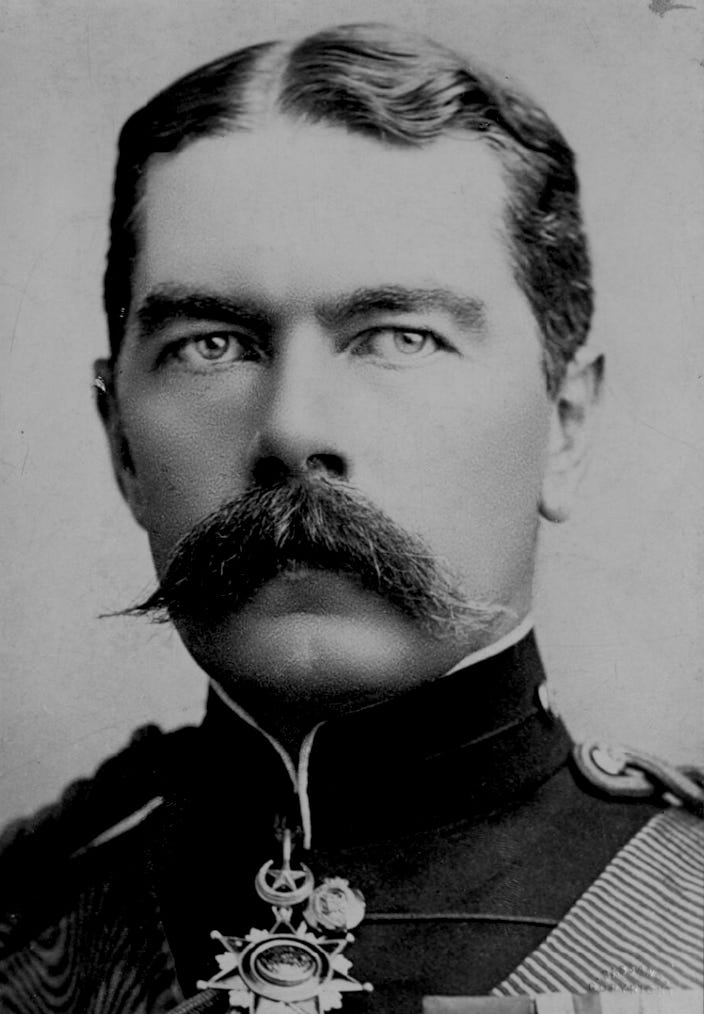
Like the rest of Western Europe, Kitchener was paying no attention to Austria-Hungary or Serbia throughout July, and the reality of the situation only hit home for anyone west of Berlin after the feckless Austrian ultimatum was delivered to Serbia at the end of the month. Ever since the Curragh debacle the previous March, which resulted in the resignation of the Secretary of State for War, Prime Minister Herbert Asquith had been filling the empty role himself. Now, with war looming he realised that he could not continue to shoulder the burden of the two jobs at once.
Kitchener had been home from his post in Egypt for the summer but was about to leave when late on 3rd August, Asquith had dashed off a note. “I was very sorry to interrupt your journey today, and I fear I caused you inconvenience. But with matters in their present critical position I was anxious that you should not get beyond reach of personal consultation and assistance.” Kitchener had made it as far as Dover. On 5th August Asquith managed to convince him to step into the breach at the War Office. “It requires the undivided time and thought of any man to do the job properly… [He] was, to do him justice, not at all anxious to come in, but clearly understood… and… his place at Cairo is kept open so that he can return to it when peace comes back.”
The post had been sold to Kitchener as his duty to King and Country, neither of which he was likely to turn his back on. Inside Whitehall, Kitchener’s appointment as Secretary of State for War was not a wholly welcome decision. He was not a politician, and Asquith did not expect him to be. The Prime Minister was also under no illusions about the abrasive Cabinet member he was assuming, but for him, it was worth the risk. He was getting an icon, one that was willing to slot into his Government in Britain’s best interests. Asquith’s action was shrewd, for he was projecting the image of national unity with this non-partisan appointment. It also saved his own skin, for he was facing a political disaster over home rule in Ireland. But his actions were honest too. At this time of crisis he did not reach out to Kitchener for the sake of his Government’s survival alone. He believed him to be the best man for the job.
Recruitment
Given what he expected in terms of the war, Kitchener was under no illusion about the size of the task in front of him. Allegedly when he walked through the door to take up the post, he was asked to give a specimen signature to keep on file. The pen they gave him was a dud, and as he flung it down he apparently said “What a War Office. Not a scrap of an army and not a pen that will write.”
Keep reading with a 7-day free trial
Subscribe to Alex Churchill’s HistoryStack to keep reading this post and get 7 days of free access to the full post archives.