
ARTICLE: NOTABLE TRIALS: Talking Yourself to Death

I haven’t done one of these in a while, so I thought bring you some more historical true crime. These cases come from a series of books about notable trials in legal history produced just before the First World War. Scroll down to find out about an idiot who might well have got away with murder if he hadn’t been such a smug know-it-all on the stand.
Before that though, just a very quick line on a tour this summer. We’re running an exclusive trip to the Somme from 5th-8th June with not one, not two, but THREE authors published on the subject as your guides. As well as myself, you’ll hit all the highlights of a tour of this crucial WW1 battleground in 1916 with Peter Hart AND Richard Van Emden, who will be on a battlefield tour for the first time.
You can find out more about that here:

The case against Frederick Seddon and his wife in the spring of 1912 was circumstantial. The evidence was built solely on proving what he might have had to gain from the death of his lodger, ‘a chain of gossamer links joined together with immense ingenuity, and it was the length of this chain rather than its strength which enabled the prosecution to bind it round the prisoner.’ The case was also significant in that you had two people, indicted for the same offence, taken to trial with the same evidence, in which the jury could have decided in any one of four ways. How then, did Frederick Seddons end up swinging when literally no witness could place any arsenic in his hands, and his wife sailed off into the sunset? Arguably, because he was really unlikeable. Had he appeared less self-impressed, more contrite on the stand, then perhaps things might have gone the other way…
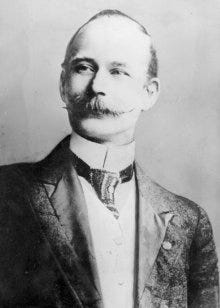
Frederick Seddon (Wikipedia)
Our story takes place in London, at Tollington Park. This street, at the turn of the 20th Century, was ‘a road having pretensions to more than mere respectability. Its houses suggest… a crescent and gratified prosperity. You feel that the people who live there have come not from a better neighbourhood but from one not so good, and that they are proud to live in Tollington Park.’ Those pretensions paid off. A five bedroom, semi-detached house on this street like the one where our murder takes place will currently set you back about £2,000,000.
We’re concerned with No.63, which is now subdivided into flats. Here, in 1910, lived Frederick Henry Seddon, a businessman with fingers in many pies, who was 40; his wife, Margaret, aged thirty-seven; his father, and five children. Our perpetrator was in fact, a scouser, and he’d moved south having made good. He liked making money:
He was conceited, but had no false sense of dignity, and seemed to be singularly free from the snobbish pursuit of appearance which is so often a weakness of his class. He was not ashamed of turning his hand to anything in the way of business by which money could be made… He was one of those people for whom the word business. has an almost sacred significance, and there can be no doubt that money was his god. No transaction was too great or too small for him, provided there was profit in it-whether it was buying £1,600 worth of property, or (although he was a very prosperous man for his walk in life) exacting the sum of 6s. each from his two young sons for their weekly board, or buying and selling old clothes, or going and making a row at a music hall where he alleged, but of course could not prove, that he had been given change for a florin instead of half a crown.
With this in mind, six members of his family, including his aged father, were crammed into a single room with a partition, so that he might have the entire top floor free for a lodger. And the lodger that he found, well. She sounds like a bit of a wrong’un…
Keep reading with a 7-day free trial
Subscribe to Alex Churchill’s HistoryStack to keep reading this post and get 7 days of free access to the full post archives.