
ARTICLE: Pétain, Origins.

Several times recently I’ve been asked “what can I read about Pétain,” be it for a First or Second World War viewpoint. The answer is, in English, not a lot. I have absolutely no intention of one-day writing a biography of this complicated man, who went from from hero to absolute zero in brutal fashion. I’d rather do one of Foch. What I don’t mind doing, however, is a multi-parter here on Substack aimed at giving anglophone audiences an introduction to France’s number one pariah. So let’s start at the beginning, with who he was and where he came from…
Henri Philippe Bénoni Omer Joseph Pétain was born late on the night of 24th April 1856, and would remain highly particular about all of those names until the day that they came to arrest him in 1945. He came into the world at the family farm midway between Lens and St. Omer in northern France. The land that was ravaged in the years 1914-18 as part of the British sector for the most part, it was in his blood; both before and after the industrial revolution that carved up the Artois landscape in search of coal. HIs family were locally prominent, but hardly aristocratic. Neither were his ancestors particularly military minded. An uncle fought in the Crimea and participated in the siege of Sevastopol. Here, the glory ended because he then deserted and set up home in Russia.
Pétain himself was the fourth of five children, and the only son. His mother punched out all of them in the space of five years and died in her early thirties, when the future leader of France was still an infant. Perhaps unsurprisingly, his father was quick to find a stepmother for his large brood, one whom would add three more children to the family. Apparently, every time one was baptised, Pétain’s father would call out at the end of the service: ”See you next year, Father!” Which sounds a bit glib when you examine what was happening to all of those kids.
The stepmother had enough on her hands with her own three children as they arrived, all of whom were born before about the time the eldest from the first marriage had turned ten. She was allegedly neglectful of the first five, and Pétain himself was clearly impacted by the lack of a mother figure if you accept his claim that he did not speak until he was three. He and his full siblings were farmed out. The eldest, Marie went to live with an uncle, whilst Philippe and two more sisters, Adélaïde and Sara, went to their paternal grandparents less than 50 metres from their family home. They were a devout pair, and Pétain’s early years, for which there is no extensive account, consisted of school. catechism classes at the parish church, and helping on the family farm. One thing we do know is that Pétain’s grandmother Hyacinthe was likely the influence that instilled a religious fervour in the young boy.
His late mother’s family were not absent, either. In fact, they were highly influential when it came to shaping the future soldier. HIs great-uncle, Philippe-Michel Lefebvre had been conscripted into the revolutionary army and served in Italy under Bonaparte before returning to France to teach and become a priest. Then there was his mother’s brother, Jean-Baptiste Legrand, a priest and a former teacher at a Saint-Omer college. One biographer of Pétain has postulated that as a boy he was inspired by both Philippe-Michel’s military tales and that his uncle’s rectory acted as a “religious greenhouse.”
The next phase in Philippe’s development began in October 1867 when he was enrolled at his uncle’s former college in Saint-Omer. A huge, red brick complex, the students wore prim little uniforms with a kepi that gave them the aspect of soldiers. This was no accident:
This establishment… has long been known for the excellent education it provides and for the large number of students it has trained for all kinds of careers. The French courses there last five years and prepare young men to pass with honor the military volunteer exam and other exams unrelated to the study of classical languages.
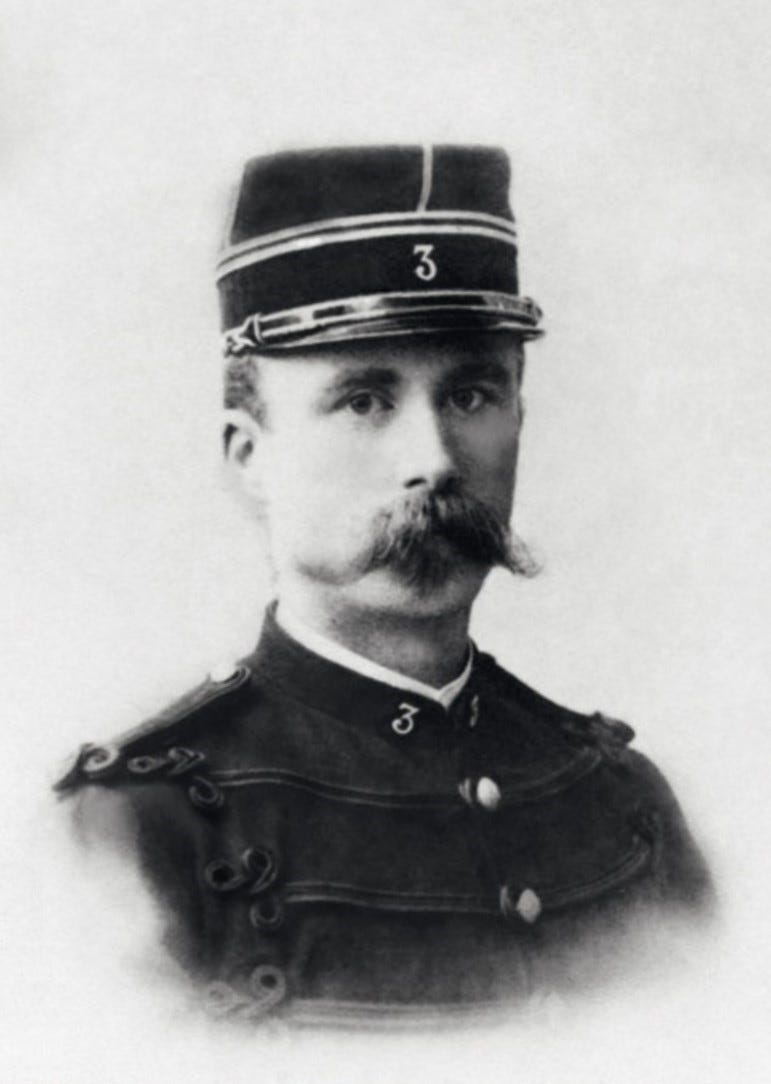
Pétain in the 1880s (Wikipedia)
Keep reading with a 7-day free trial
Subscribe to Alex Churchill’s HistoryStack to keep reading this post and get 7 days of free access to the full post archives.