

The milice, if you haven’t been reading along for the last week, were some of the worst that France had to offer during the Second World War. There were perhaps in excess of 30,000 members, and it was responsible for assassinations, torture, executions, rounding up Jews for deportation and many other heinous acts before the end of the war. Last week I looked at the deep origins of how all this came about. You can read those two short articles here:


Today, I want to give a more expansive view of the last part of this torrid journey, where fringe characters and agitators came to full prominence, enabled by the Vichy State, and the Milice was founded in 1943.
We left off with the founding of the S.O.L, the Service d’ordre légionnaire in 1941. Joseph Darnand now had his own band of extremists, many of whom had demonstrated that they were more than willing to resort to violence to further their hardline, right-wing agenda.
The founding of the S.O.L coincided with the German invasion of the Soviet Union. From now on, it was going to be a downhill slide toward defeat for Hitler, but it would be a long time coming. In France, Operation Barbarossa was not a distant war on the other side of Europe, this was an existential battle between right-wing Germany and Communist Russia. What did it signify for Pétain’s government’s own survival if the latter delivered a defeat on the behalf of the political left? Worst case scenario: the 1790s all over again. Another revolution. And even if Vichy weren’t hardline Nazis, they definitely didn’t want to see that. For Germany, the quieter and more docile their occupied territories remained, the better. Vichy and the French right wing, be it actual fascists or just conservatives who were obsessed with the threat of communism, were only too happy to oblige in ever-growing numbers…
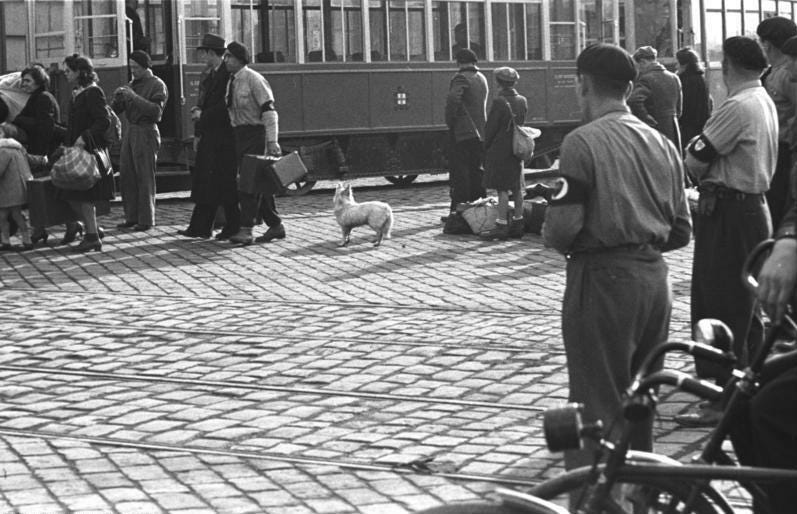
Members of the SOL during the Marseille roundup in January 1943. (Wikipedia)
Darnand was still in Nice, and occupied with the S.O.L. It was a change in direction for he and his crew, because this time his organisation was acting like a political party, with it’s own leaders and a growing ethos as opposed to seemingly doing someone else’s dirty work. To begin with, they were, of course, for Pétain. Aggressively so. They were vehemently against Communists, a French Republic, as opposed to a monarchy or if not an authoritarian regime, and Jews. Nice was a long way from Vichy, and from scrutiny, and with a name like Darnand’s at the top of the bill, they were free to press on. By the end of summer, 1941, Darnand was in control of the Legion for the whole of southeastern France. His influence was spreading, to Aix-en-Provence, Nîmes, Montpellier, Narbonne, Carcassonne, Valence, and Annecy; and his numbers were growing.
Where did the S.O.L. find willing participants? Lower level leaders migrated across from all manner of right wing organisations: lawyers, doctors, landowners, minor gentry, many of whom, of course, had been officers in the last war. At ground level they were bourgeoisie, including women, farmers, students. Organisations like this pillage their branding from others, bastardising as they go, grifting legitimacy from recognisable sources. As well as conservative ideology to which they could belong, S.O.L. members were also rewarded with a uniform mimicking that of the army: khaki shirt, beret and a black tie which was supposed to a sign of mourning for their beloved, defeated France. Their motto, they nicked from Georges Guynemer, a First World War fighter ace; and their emblem was a Gallic helmet with shield and sword. Their hymn, Chant des cohortes, was their own, and with a bit of amending, it would carry through to the Milice. As is evident, their stall was set out by harking back to the Crusades for a vibe. It’s pretty tedious, but here is some of it:
The saviour of immortal France
Has made a radiant ideal shine forth
The victor of Verdun calls us,
Let us answer: “Present!” to the Marshal!
Come quickly to our stalwart cohorts,
O all you who are intoxicated by battle:
The S.O.L. will make France strong
Through those who will not tremble!
…S.O.L., let us make France pure:
Bolsheviks, enemy Freemasons,
Israel, vile filth,
Disgusted, France vomits you out.
On our knees, we swore the oath,
S.O.L., to die singing
If need be, for the new France
Lovers of glory and grandeur,
All united by the same fervor,
We swore to remake France:
On our knees, we took this oath.
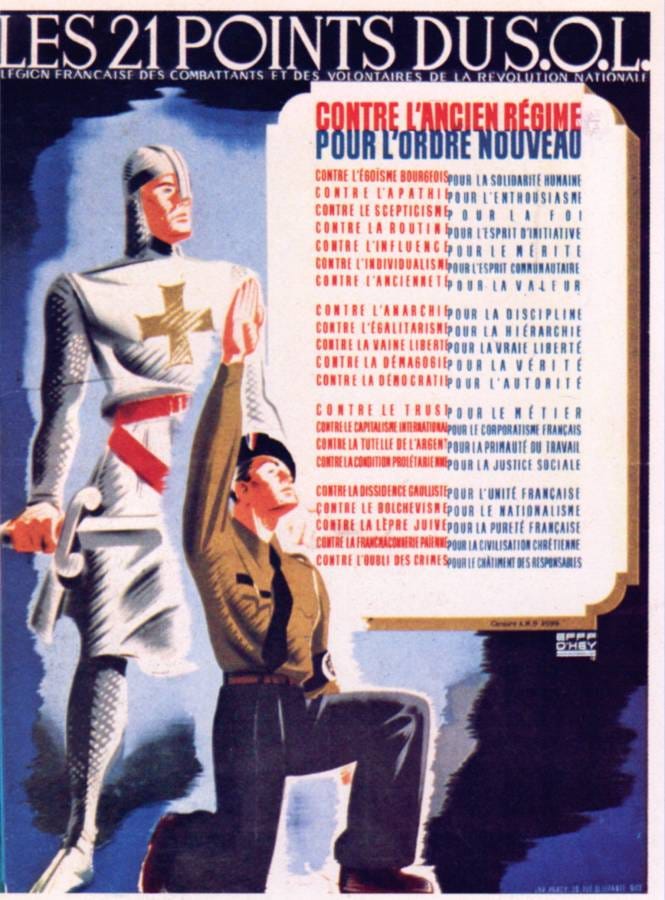
The S.O.L expanded on their anthem with 21 points, the basis of their political programme. This photo compares the old regime with how they’re apparently going to fix everything. (Wikipedia)
Darnand was by this point a collaborationist, but not stupid enough to say that part out loud. Baby steps, remember, is how you get a mass of people to follow your wilder ideas. One thing at a time, until they wake up and don’t know how indoctrinated they’ve become. At first, the S.O.L vented their energy with parades, meetings, and flag ceremonies. You saturate your audience with shiny pageantry and pithy slogans. But they also began messing with the locals; be it punishing someone for not removing his hat in front of the French flag, or harassing Jews. Soon, regional officials were complaining about their meddling in affairs; attempting to suppress the black market themselves, or blacklisting political opponents. They also came into conflict with the older Legion of Veterans, who thought all of this marching and aggression a bit much. It rather looked like Joseph Darnand was backed into a corner, but then Admiral Darlan, Pétain’s designated heir and Vice-President of the Council paid a visit to Nice and backed the S.O.L. He thought perhaps this group could form the nucleus of the National Revolution.
Darnand began regularly visiting Vichy by the end of 1941, garnering support for the S.O.L. from Pétain himself. Matters were complicated in terms of organisation, they could not just supplant the original Legion of Veterans, and so to cut a long story short, the organisations were mashed together, The S.O.L. had regional heads, but at department level, they were under the authority of the departmental head of the Legion, who also had a departmental S.O.L. chief to work with. They functioned as a separate security service within the Legion, and Darnand himself was Inspector General. As such, he decided on what training and lectures his people received.
They were not, however, allowed to walk the streets acting like a day to day police force picking on random citizens to generally enforce the law. They had four specific jobs to protect the regime:
1. Identify sources of anti-government propaganda
2. Detect and monitor signs of unrest
3. Suppress anti-government activities
4. Guaranteeing the functioning of public services under all circumstances.
As such, it was already accepted that there would be violence involved.
[They] must therefore be able to deal with demonstrations directed against the Marshal and his government, to suppress incidents, disturbances, and possible riots—in short, to maintain order. (...) To be able to carry out this difficult task, the SOLs must have a thorough mastery of the necessary techniques, particularly street fighting. They must be accustomed to assembling rapidly at any time of day or night. (...) A departmental SOL must constitute a solid, homogeneous force, mobilisable within a few hours, and obedient to the letter. (...)
That said, the Legion was far less extreme, and held back the S.O.L. from how it really wanted to operate. It didn’t seem like they would see a lot of action. The enthusiasm which ushered Pétain into power had waned, and though people weren’t necessarily actively resisting, ‘growing passivity’ was more a feature the winter of 1941-1942. You don’t get away with clubbing those people. So reasonably, Darnand’s disciples would find few opponents out there, which wasn’t what they wanted.
In January 1942, Darnand permanently relocated to Vichy, of course taking Marcel Gombert with him along with several other regular flunkies and they set up shop in the Hôtel de Lisbonne, overlooking a grim courtyard. However, now officially recognised, the numbers of the S.O.L boomed. By February, they were holding public investitures drowning in fascist pomp with flags and uniforms.
The more reserved Legion and the S.O.L. were never going to be able to coexist, and with the former baulking at collaborationist policies, frustrations built on both sides. What Darnand desperately desired was a ‘supplementary paramilitary political police force, which would lead to its separation from the Legion and the latter’s deactivation.’ He had reason to think he was on the verge of success, but there was a significant problem: Where would their money come from if the severed the connection?
Then, in true authoritarian back-stabby fashion, Admiral Darlan was ousted and back came Pierre Laval. That shook things up.
Now, apparently in April 1942, one shrewd minister said to Pétain: ‘Germany has lost the war. She will drag into her abyss all those who have marched or seemed to march in her wake. Beware, Marshal, of outliving your glory.’ It is prudent to point out, too, that Pétain’s cognitive ability was waning before the eyes of anyone in close proximity to him, giving him a fickle aspect that was hardly reassuring in a head of state. He was being shuffled out of the way as much as possible. He was seen in public less, and when he was, he was increasingly told where to go and what to say.
All of this meant that realistically, Laval was basically head of state. Vichy’s play in all of this turned out to be aggressively installing itself, permeating all levels of French bureaucracy, to such an extent that whatever transpired in the war, they would be immovable. That said, Laval personally was adamant that Germany was going to win the war. ‘The Parisian extremists felt the same way: the idea that the Wehrmacht and the SS could not triumph over the Judeo-Marxist hordes and Roosevelt’s “Negroes” was unimaginable to them.’ Laval went on a boot-licking expedition in trying to prove how valuable he was to the Nazis; starting in May when he offered French workers for German factories.
He did not trust the S.O.L. Now Darnand found not only the Legion in his way, but Laval, and to add another annoyance to the mix, Secretary General of the Police, René Bousquet, Laval’s protégé. Once again, moping in his hotel, Darnand stared into the abyss. Beware the monster you create as a budding fascist too, because he had a whole gang of angry S.O.L. members chomping at the bit and wanting a fight too, and had to be wondering if he could rein them in if necessary.
Once again, he got lucky, because Laval didn’t like the leaders at the Legion either. A complicated coup ensued, in which finally, a Laval lackey was installed in charge over there, but Darnand was assured he wouldn’t meddle in the S.O.L. After a short time, Laval also appeased Darnand more, by appointing him the Legion’s permanent delegate to the head of government. Nice try, but he wasn’t satisfied.
Now, you’re going to bear with me for a bit, because I need to sketch something out for you. As ever, the French are a complicated bunch. Darnand was in the unoccupied zone. In the north, they had their own mob, called the Legion of French Volunteers, or LVF. Laval would quite like to get rid of them, but instead, in the second half of 1942 he launched an initiative to almost bring them under his control instead. This amounted to founding, on paper anyway, the Tricolour Legion and attempting to unite collaborationists both north and south of the demarcation line dividing France. A lot of effort went into it. One of their propagandists took to a stage and said:
This body, formed with the approval of the German authorities, both civil and military, will receive German weapons and equipment. Its first objective will be to reinforce, improve, and organise the former “Legion of French Volunteers,” which it will gradually replace. It will strive to establish, as quickly as possible, a light division under French command, reporting to the German army corps to which it will be assigned.
Since the fight against Bolshevism remains the principal factor in the current war, it is to this fight that the “Tricolour Legion” will initially contribute. But, once this enemy is defeated, we can look elsewhere, and nothing will prevent the Legion, capable of being deployed wherever the Government deems France’s interests to be at stake, from being used in the defence of the Empire.
…Everything that Germany allows us to attempt and accomplish in the relatively minimal areas of assistance we are capable of providing is a ‘gift’ that she gives us. For what is a French division, or even a French corps, lost in this army of 5 million men whose every nerve, every mind is on edge with this single will that promises them victory? It is, in short, a symbolic gesture that we are making, much more than actual aid, and this gesture would allow us to one day say to our former victors: “We were with you.”
Collaborators from both zones were invited to join this nonsense, including Darnand, who was sent as head of a delegation to meet with the LVF. In the meantime, throughout the summer of 1942 several large investitures took place as the S.O.L. ushering in thousands of new members. At Lyon, where 4,500 were sworn in, Darnand nailed his colours to the wall now. They were red, white and black:
I saw Germany at war. I saw it calm, orderly, and dedicated to the gigantic task it has undertaken, with a widely accepted discipline, and without brutal coercion. I sensed the sincerity of this nation’s desire to avoid the return of the pointless wars that, for centuries, have pitted it against a France to which it retains, even in defeat, esteem and respect. I painfully sensed his astonishment at the reluctance of our own people, who didn’t seem to grasp the generosity of the German gesture. I spoke at length with French workers who have been working there for a long time and are now integrated into the lives of the German people. They confirmed my personal impressions.
…The Legion of Combatants and its S.O.L., maintaining complete independence… did not wish to remain uninvolved in a government initiative that corresponds to its views and its ideals. I now see our duty with a clarity bordering on the self-evident. I will say it in a word: our duty is to be among those who, in the Tricolour Legion, will be at the forefront of the European struggle.
My words are serious, heavy with meaning. I know that for some they entail profound changes in their individual destinies. That is why I weigh my words carefully and read them, even though I would like, as usual, to speak to you frankly, without notes in hand and looking you straight in the eye, like a leader who loves his men, who has their complete trust. I tell you, therefore: we must be represented in the Tricolour Legion. The S.O.Ls will prove within its ranks that we are sons of France who will make every sacrifice as soon as the Fatherland demands it.
There was then a lot of blithering about Joan of Arc and the English but you get the idea. March forth with Hitler. Soon after, Laval was at it on the radio:
I am determined to re-establish normal and trusting relations with Germany and Italy. From this war, a new Europe will inevitably emerge... To build this Europe, Germany is waging gigantic battles… I wish for Germany’s victory, because without it, Bolshevism would take root everywhere tomorrow… When I tell you that this policy is the only one that can secure France’s status and guarantee its development in future peace, you must believe me and follow me… Frenchman, a great soldier, whose entire life is an example of sacrifice and discipline, presides over the destiny of the nation.
Etc., etc. The hilarious part of this is that the Germans, who obviously would have had to support this venture, decided it was a stupid idea to give a lot of occupied people a lot of weapons and knocked the whole thing down before it got started.
Yet, for Darnand, he had now been brought into contact with his opposite numbers in the northern zone; not to mention the Nazis. He visited Paris several times in summer 1942, met with German officials. They now viewed him as a ket figure south of the demarcation line. They courted him, and he enjoyed it.
…Overcome by his ambition, and it could hardly have been otherwise: Darnand was too sure that, given the means, he would be capable of putting the National Revolution back on track, of punishing the “traitors,” of chastising those responsible for the war and the defeat. He wanted power. And who in France, as early as the summer of 1942, was providing it? Pétain, Laval, or the “victors”?
In the south, he S.O.L. had been getting more brazen. In Nice they occupied a synagogue. In Nîmes, Montpellier, and Aix-en-Provence, officials complained that the S.O.L. were demanding to see peoples’ I.D., rifling through the homes of Jews and suspected followers of de Gaulle. One of the most famous incidents of this idiocy was carried out on one François de Menthon; a veteran himself and a professor of law in Lyon. Suspecting that he was affiliated with the resistance (which he was), in May 1942 he received a letter demanding he attend the mayor’s office. Diligently, he cycled over there to find it shut up. He was about to go home again when half a dozen youths appeared. They ‘surrounded him violently and abruptly, grabbing his wrists and shoving him, carried him towards the fountain basin a few meters from the town hall entrance, then plunged him into the basin filled with water. While he was in this position, some of the bystanders called out to him, saying: ‘Cry Long live de Gaulle! Now!”’
The police arrived, liberated the poor man and he filed a complaint. It was established that the Annecy S.O.L. was responsible, and five members were charged. The perpetrators claimed falsely that he had been engaged in illegal activity and therefore asked for it. At this point Darnand intervened and instructed the local office that they were ‘to declare that they acted only on the orders of Joseph Darnand… Inspector General of the Legionary Security Services.’ At a commission he testified:
My general orders have been given to act against any person engaging in blatant Gaullist propaganda or displaying Gaullist sentiments too openly… I believe that the act of violence against Mr. de Menthon falls within the purview of the SOLs. The powers granted to the SOLs are broad enough to cover the harassment inflicted on Mr. de Menthon. However, the powers granted to the SOLs do not extend beyond simple acts of violence. These powers are not authorised by any legal text. The SOLs are the sole judges of the methods they must employ.
So unchecked thugs acting on behalf of the regime without proper oversight. Check.
If the power to do this stuff isn’t written down anywhere then who authorised it?
Darnand did not need to concern himself which such trivialities, because Laval had his back. An official interviewed in 1945 stated:
I hoped that those responsible would be punished. But… Mr. Laval… rudely ordered me that there be no further legal action. I still remember the sound and tone of his voice and the arguments he gave me.
The case was tossed out, but what starts with a dunking in a fountain ends with people getting shot.
In public, Darnand continued to champion the National Revolution, collaboration and of course, Pétain. This dented the membership somewhat, to the tune of about a thousand official resignations by those who weren’t up for that. More walked away without saying anything. What it did meant though, was that the new recruits coming in knew exactly what they were signing up for. The S.O.L. leaned further towards the pro-Nazi sentiment.
Sections were formed in Algiers, Oran, and Casablanca. A leadership training school was established near Lyon to indoctrinate potential officers. More broadly, of course, because this is what authoritarians do, fake news was employed. 20,000 odd members may sound like a lot but it doesn’t make for an impressive looking army. When they held parades, they would bus in members from further afield to make the crowds look bigger. Fake leaflets supposed to be produced by Gaullists were distributed with lies aplenty. They’re the evil ones, not us.
On 8th November, 1942, a huge blow was struck against the Vichy regime when Operation Torch was launched in North Africa. Pétain ordered the Army of Africa to resist. Lots did. Some didn't . Then at home, when the Germans crossed the demarcation line on 11th November and occupied the rest of France, the Armistice Army did nothing. They had been forbidden from resisting by the Minister of War. The move had little do do with the Allied move in Africa. Laval, he had authorised the entry of 280 advance Abwehr and SD agents carrying false French papers south of the demarcation line as early as September.
Vichy was now entirely a puppet regime. As for the collaborationists, Darnand included, they screamed for France to declare war on the Allies. It did not come, and on 18th November, Darnand tendered his resignation:
…In foreign policy, we support a military alliance with Germany, the logical outcome of the policy initiated at Montoire by the Marshal, who asked us to be its defenders and architects, and eager to see this internal revolution come to fruition, of which we have chosen to be, behind the Marshal, the fighting vanguard, we do not understand the inertia and vagueness in which we seem to be kept at a time when, more than ever, it is necessary to “take a bold stand.”
Recent conversations with the Head of Government have revealed a profound disagreement between the commitments made to my men and the actual results that the S.O.L. can normally expect from government decisions.
I have now lost hope of seeing the S.O.L. play the role I believed it was destined for, both in the mind of the Head of State and in my own: the realisation of the National Revolution.
“At a time when the country is collapsing into the indescribable chaos of betrayals by the civilian and military leaders in whom the Head of State had placed his trust—betrayals that we have relentlessly denounced for two years—I refuse to be ambiguous and wish to demonstrate my loyalty. Not wanting to betray either the Marshal’s trust or that of my men, I am compelled to submit my resignation as: Permanent Delegate of the French Legion of Veterans to the Head of Government, and as: Commissioner General to the S.O.L.
I feel, in leaving, the bitter regret of unused volunteer work. I was ready, in fact, as in 1914-1918, as in 1939-1940, and following the example of the S.O.L. in Oran and North Africa, to offer to the country, without any compensation and with all the comrades I was able to rally behind me, our devotion as legionnaires and our lives as French soldiers.
The day after Darnand resigned, Pétain addressed the French people on the radio at 9:30 p.m. His language was straight out of the dictator playbook:
French people,
General officers, in the service of a foreign power, have refused to obey my orders. Generals, officers, non-commissioned officers, and soldiers of the Army of Africa, do not obey these unworthy leaders. I reiterate my order to resist Anglo-Saxon aggression.
We are living through tragic times; disorder reigns in people’s minds. You are listening to news whose sole purpose is to divide and weaken you. The truth, however, is simple: by failing to submit to the discipline I demand of you, you are putting your country in danger.
In the interest of France, I have decided to increase President Laval’s powers, to enable him to accomplish a difficult task. Unity is more essential than ever. I remain your guide. You have only one duty: to obey. You have only one government: the one to which I have given the power to govern. You have only one homeland, which I embody: France.
So what was Darnand going to do? Because let’s be honest, pipe and slippers next to the wireless was obviously not going to suffice. On 21st November he spat out a radio address to try and recruit men for an Imperial Legion, to fight in Tunisia alongside the Germans: the Imperial Legion, which was to fight in Tunisia alongside the Germans, the “African Phalanx.”
…Without any justification, without any pretext, without any warning, after a policy of hypocrisy and corruption, English and American troops threw themselves upon North Africa... It is on this land, now truly ours, that the soldiers of Jewish and Anglo-American imperialism came seeking an easy victory... A few wretches... agreed to be accomplices of the invader... My heart has never beaten for anything but my country... Today, I accept the idea of seeing, side by side, Frenchmen under their flag and their weapons and Germans under their flag and their weapons striking the same enemy.
He had no intention of going anywhere now. Applicants were invited to send a note to the Hôtel de Lisbonne. This African Phalanx, whatever you wanted to call it, [‘phalanx’ was a fixation of Darnand’s] was about to jettison the old Legion once and for all, with Darnand at its head, and the Milice was about to be born.
A Bill was prepared that would make the S.O.L. the core of this new organisation. It stated that:
Article 1:
“The French military collaboration with the Axis powers, with a view to conducting joint operations against the Anglo-Saxon powers and their allies, is ensured by the French Phalanx.
Article 2:
“The French Phalanx comprises large combat units of all branches and their support services, as well as a Phalanx air force. It also groups together, for the internal struggle against dissidents and the maintenance of order within the territory, metropolitan formations that constitute the Phalanx militia. Finally, it includes propaganda groups.
There was also a provision for siphoning off any funds allotted for the Tricolour Legion and assigning them to this new group, also granting it the same mission as that failed enterprise, including a militia ‘whose mission will be to fight against the Resistance.’
Once again, the Germans were not keen on sharing a battlefield with a vanquished enemy, so once again, they declined; but only in part this time. They would quite like a limited African Phalanx for Tunisia, for propaganda as much as anything. And, they said, you can have your militia. Or in French, your milice.
Laval had had something like this in mind already, but now he was able to appease the Germans. Why a new organisation? He wanted to prevent Darnand, who he was cagey about, from linking up with those collaborationists in the northern zone whom he really didn’t like. He believed he could at lease control Joseph Darnand. He was the lesser of all the evils at this point. Pétain, who’s basically doolally at this point anyway, agrees. So did the Legion, the old one. They were glad to be rid of the fascists in their midst and hoped the S.O.L. would now just collapse. Laval made himself the chief of this militia, with Darnand as secretary general.
They wheeled out Pétain to sell this. He announced the formation of the Milice to leaders of the Legion.
The S.O.Ls, by serving at the forefront of the Legion, have demonstrated to me their devotion and dynamism. By shedding their blood for the Fatherland, the SOLs of North Africa have proven to me that their loyalty makes them capable of making the ultimate sacrifice.
Today, along with the police, they remain the only organised force capable of maintaining order. If they did not exist, reason would dictate creating them to block the path of the occult and evil forces that seek to annihilate us.
That is why I have made the decisions I am about to announce to you:
…They must be at the forefront of maintaining order within French territory, in conjunction with the police forces.
To facilitate their task, I believe they need a certain degree of autonomy.
Therefore, under the command of their National Leader Darnand, they will henceforth report to the Head of Government in the form of the National Militia.
The formation of the Milice was enshrined in law on 31st January, 1943. Here are some of the lowlights:
The French Militia, which groups together French citizens resolved to take an active part in the political, social, economic, intellectual, and moral recovery of France, is recognised as being of public utility. Its statutes, attached to this law, are approved.
…The Head of Government is the head of the French Militia. The French Militia is administered and directed by a Secretary General appointed by the Head of Government. The Secretary General represents the Militia in its dealings with third parties.”
…The French Militia is composed of volunteers who are morally prepared and physically fit, not only to support the new State through their actions, but also to contribute to the maintenance of order.
And here are the requirements for joining:
Members of the French Militia must meet the following conditions:
1. Be French by birth.
2. Not to be Jewish.
3. Not to belong to any secret society.
4. To be a volunteer.
5. To be approved by the departmental head.
The inaugural meeting took place on the same day, at the Hôtel Thermal, ‘lavishly decorated with the tricolour flag,’ There followed a lot of mutual arse-kissing. Darnand’s speech was long, and it’s easy to imagine how smug he must have been. He’d won.
To those who persisted in considering us mere reactionaries, we have openly declared our desire to see a national and socialist authoritarian regime established in France, enabling France to integrate into the Europe of tomorrow. Our convictions have not changed. They will not change. The 21 points of the S.O.L. remain the political charter of the French Milice.
Agents in the pay of England, America, and Russia are campaigning, recruiting, and arming. Taking advantage of misery and suffering, a misled crowd is ready to follow the combined leaders of Gaullism and Communism… A decadent patriotism serves as the basis for the monstrous alliance of these leaders with humiliated and ambitious warlords, to steer the popular forces toward a political struggle cleverly disguised as military revenge.” The people must be “commanded, not followed.” France no longer has an army or a navy. “For its honor, as well as for its security,” it must not rely on “the arm of a foreign power.” From now on, it has the Militia:
Its vigilance will consist primarily in detecting and punishing these acts of treason and lies. The Militia will be the government’s best propagandist. It will tackle poverty and famine, consequences of defeat.” It will suppress the black market. Provided the government allows it certain initiatives,” it will not hesitate to strike “with discernment. Every militiaman, in all things, will be an example…
It will be a military and police force of repression that will strike “with the desired rigour and publicity. Selected from among the militiamen, young men aged 18 to 45 will form an elite corps called the Franc-Garde.
This Franc-Garde will be composed of morally prepared and physically fit volunteers, not only to support the new state through their actions, but also to defend it against its aggressors, both internal and external.
To create esprit de corps, to obtain very strict discipline, and to show everyone that the Militia is an organisation with nothing to hide, and finally to compel those who support it to come forward without fear, the Franc-Gardes will wear a uniform… This Franc-Garde, organized into hierarchical units, technically trained, and prepared for combat, will always be ready to maintain order.” “Identifying centres of enemy propaganda, searching for and pursuing leaders of hostile forces, and suppressing anti-government activities and demonstrations will be the Franc-Garde’s usual duties.
In response, Laval declared:
I told you this morning that I wholeheartedly approved Darnand’s declaration and that I would do everything in my power to enable you to serve France well. These are not empty words. The road we have to travel together will be long and arduous. Your presence at my side, the faith and dynamism you demonstrate in your actions, are a comfort to me. Future generations, even if we encounter much misunderstanding today, must not be able to reproach us for not having done everything necessary to save France.
Both Laval and the man he was championing would end their days in front of a firing squad. But not before the organisation they brought into being on that day wrought havoc on France.There are no concrete figures for the body count achieved by the Militia in the years that followed, but given their complicity in acts like the deportation of French Jews, it reaches into the tens of thousands. So I suppose here endeth the three part lesson. Hate and unspeakable violence by ordinary French people against their fellow citizens didn’t arrive overnight. It never does. It was a slow, insidious creep fanned by the flames of extremism and fear that gradually normalised it all. Because somehow people forgot that it is OK to have politically divergent views without wanting to shoot each other in the face. Listen to historians people. We know stuff.
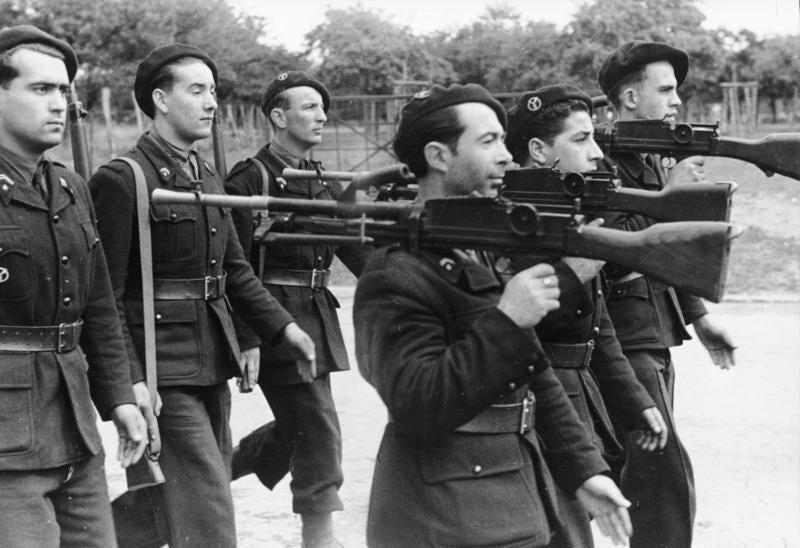
Members of the Milice pictured with pilfered British weapons. (Wikipedia)
To write this I used: Histoire de la Milice 1918-1945, by Jacques Delperrié de Bayac, published by Fayard.
I had a wee look for him in a couple of books, Defeat and Division: France at War, 1939-1942 and Resistance and Liberation: France at War, 1942-1945 (Both Douglas Porch, CUP 2022 and 2024 respectively. I’ve read the first, very good. The Second on the TBR pile). He gets a passing mention in both. His trial last five hours, jury deliberated for 15 minutes.
Nasty piece of work.