

Several times recently I’ve been asked “what can I read about Pétain,” be it for a First or Second World War viewpoint. The answer is, in English, not a lot. I have absolutely no intention of one-day writing a biography of this complicated man , who went from hero to absolute zero in brutal fashion. I’d rather do one of Foch. What I don’t mind doing, however, is a multi-parter here on Substack aimed at giving anglophone audiences a detailed introduction to France’s number one pariah. This is part four, but you can head back to the beginning by going here:

It’s now 1916, and we’ve got to the big one, if you’re French or German: Verdun. The whole justification for bringing Pétain back in 1940 was his First World War record, and this was completely tied up with an image of him as a military leader who saved the day on this battlefield. Only he didn’t. Not really. There’s a caveat to that, but let’s start at the beginning. 1915 had been a dismal year of repeated failures, and the Allies were planning a joint offensive on the Somme to try and bring about an end to the war in summer 1916. The Germans, however, had ideas of their own, and these constituted a devastating offensive launched in the midst of winter at Verdun. Early on the morning of 21st February, they opened a shattering artillery barrage on this front, bludgeoning the town itself and both banks of the River Meuse. That afternoon, the infantry burst forward, forcing the French back several miles in the first few days. France, it seemed, was once again on the brink of disaster.
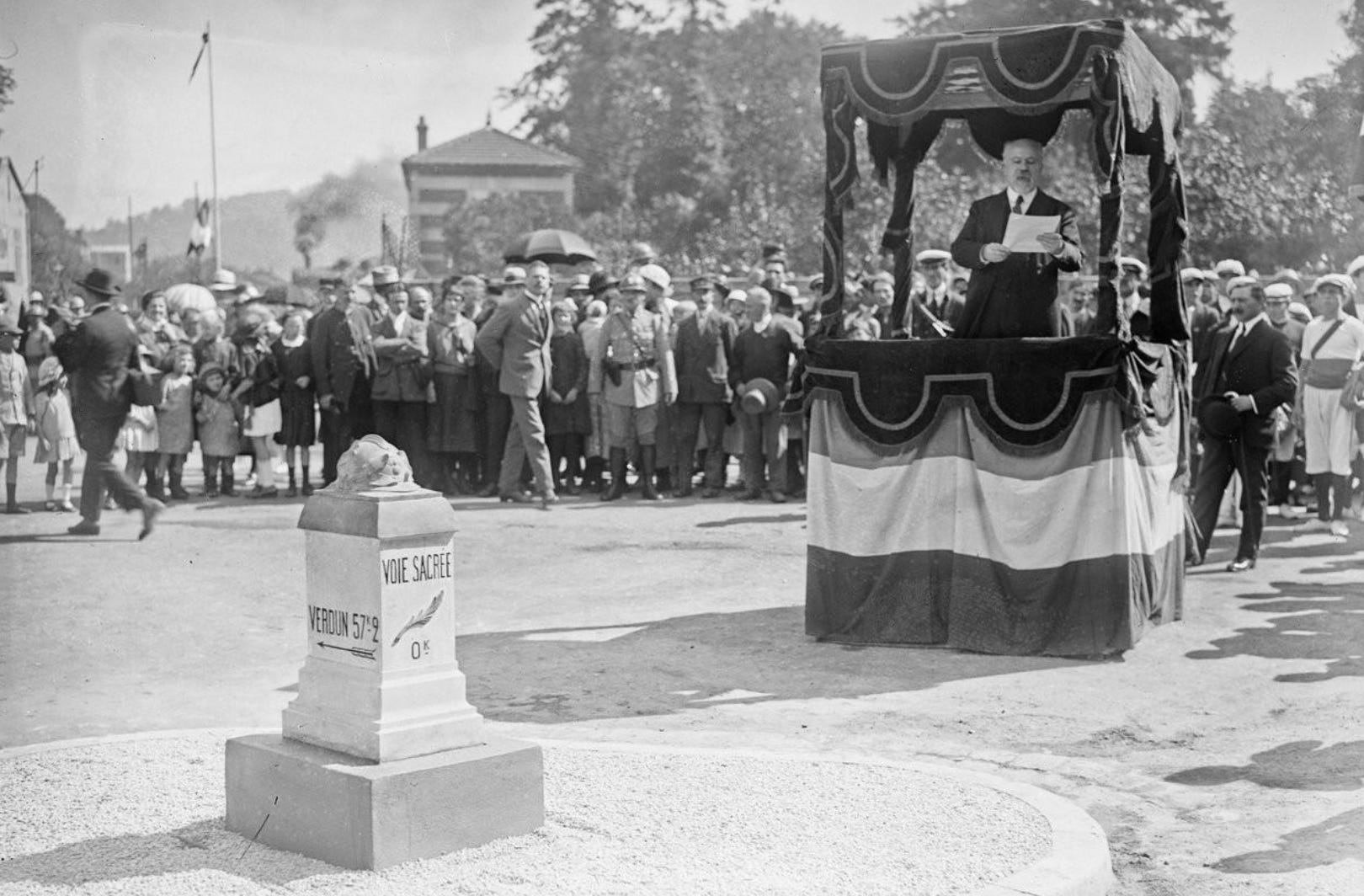
A commemoration at Bar-le-Duc in 1922 marks the importance of the Voie Sacrée (Gallica/Bibliothéque national de France)
At this point, General Joffre, in command of the French forces, summoned Pétain. At first, they couldn’t find him. Eventually, Serrigny (his faithful underling who later penned a sort of apology for his chief) rocked up at a hotel at the Gare du Nord in Paris, where he was faced with an incredulous landlady denying she knew anything about the General’s whereabouts. When Serrigny complained that the very fate of France was at stake, she showed him to a room, in the doorway of which Pétain appeared in his underwear. I’m going to give you the TMI version now because it’s burned into my brain and you should all suffer as I have suffered, but when he left Paris the next morning with Serrigny, he told the latter: ‘that, when he revealed to his bedmate the nature of the task that awaited him, she burst into tears, before lavishing such marks of tenderness and passion upon him that he would forever cherish the memory of that night.’
When he finally appeared in front of his boss, French commander in chief ‘Papa’ Joffre delivered sobering news on 25th February: the enemy had already taken up to 25,000 prisoners, along with hundreds of precious guns, and Verdun itself might be about to fall. He had repeatedly preached in favour of the defensive. Now, Pétain had to defend this sector, covered in thick snow, in terrifying circumstances. According to Serrigny, who was certainly there, but don’t forget is a bit of a biased narrator, the only sign of the ‘intense inner turmoil’ raging within Pétain was that his right eye started twitching…