
ARTICLE: With Some Help From Edith Cavell, 1915

I like Giraud, you all appear to like Giraud - so let’s go back to his WW1 adventures. (I will cover his brilliant WW2 escape properly at some point too). Here’s part one:

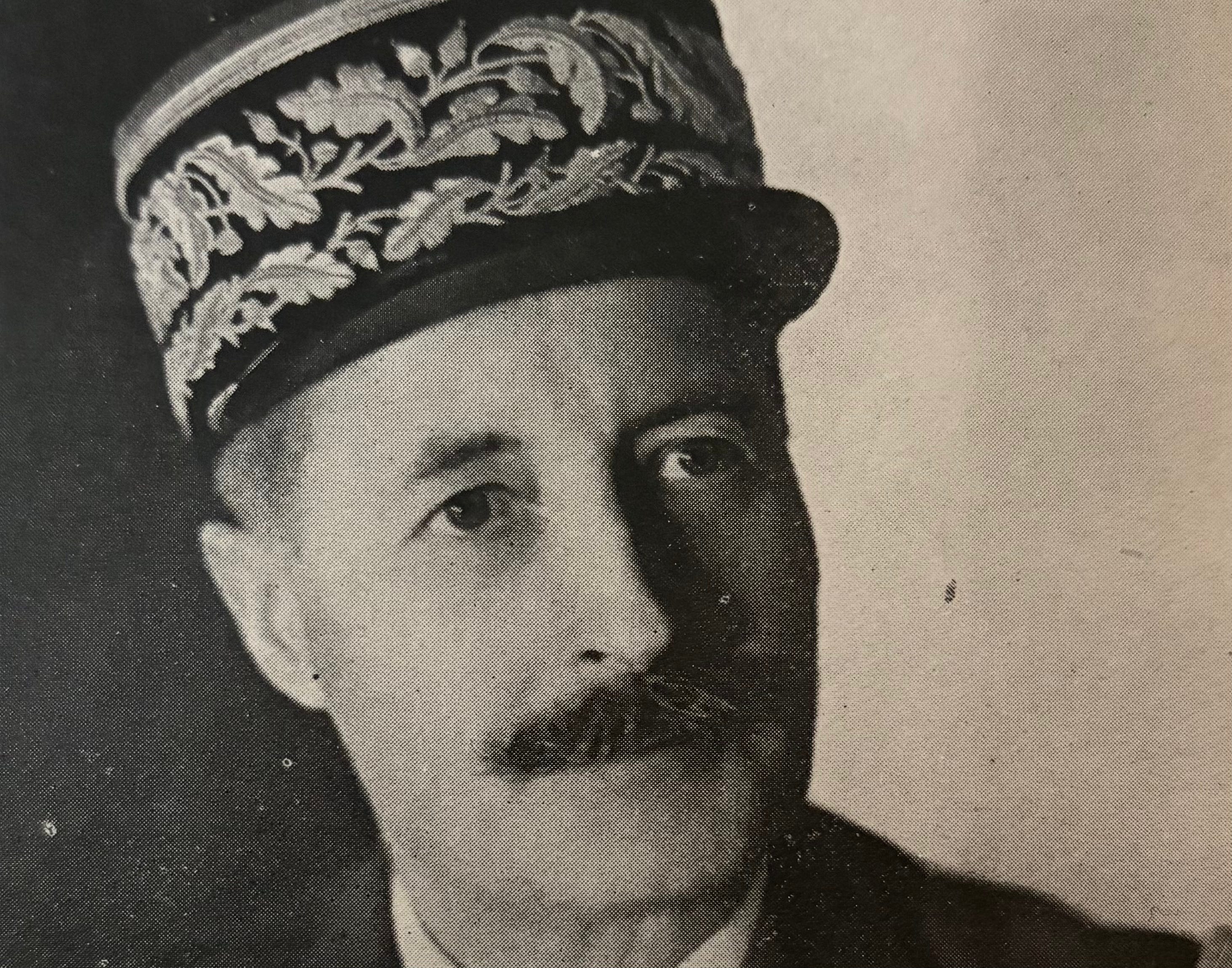
We left him in occupied Saint-Quentin in the winter of 1914-15, hiding in plain sight and working for a coal merchant. But he and his friend Charles Schmitt had no intention of staying put and waiting the war out. They had a duty to fight for France. To that end, Giraud thought he had spied a potential accomplice…
A cattle dealer was a regular at the Auberge Venet; the war had turned him into a peddler of scarce, high-value goods—butter, cheese, coffee, tea, chocolate, and tobacco. He shuttled regularly between France and Belgium, making a tidy profit on every trip, right under the Germans’ noses. He was an energetic, daring man who loved taking risks and never shied away from danger. Moreover, he knew plenty of people in the countryside who put him up, supplied him with goods, and kept him informed. A valuable card to play, should we ever want to head for Holland.
On reflection, this was indeed the wisest solution, despite the distance… The French front formed a continuous line of trenches stretching from the North Sea to Switzerland. Crossing it at any point was an extremely difficult undertaking, as all the civilians in the villages had either been evacuated or were well known to the Germans… It was definitely better to take the long way round via the Netherlands and England. When escaping—as I experienced again in 1942—a straight line is never the shortest path between two points, mathematicians notwithstanding.
Sometime in January… I sounded out Mr. Richard to see if he might agree to take me to Belgium and leave me there during an upcoming trip. I was eager to leave Saint-Quentin, and I could act as an “assistant” on one of his expeditions. Besides, being “Belgian,” I would surely find things easier in my native country. A fortnight later, the deal was struck. It was agreed that I would leave with my new boss in early February, and that he would drop me off at the Belgian border, without entering Belgium himself, as the border is currently heavily guarded by the Germans. We might face some difficulties, since surveillance of supply lines has been significantly stepped up, but he feels I am no more faint-hearted than he is and that we’ll manage to get by. Later, sometime in February, he plans to do the same favour for my compatriot Charles, the young pork butcher.
My final days in Saint-Quentin pass quietly, with no one aware of my impending departure. The day before the scheduled date, I settle my accounts with Madame Jaffary and go to inform Lambert that I am leaving. The next day brings emotional farewells from Madame Venet and her husband, who tries to remain stoic. Charles and I share a long embrace, and then—in Richard’s cart, drawn by an excellent horse—we set off north through the gloom of a winter morning.
The journey was, at first, mercifully uneventful. Travelling via Bohain and then Maubeuge, they eventually got to Gomegnies, tantalisingly close to the Belgian border. The frontier was crawling with Germans, but the farm where they were staying fortuitously had fields that straddled the border…
Tomorrow, I will set out with our host… pulling a manure cart. He himself—well known to the occupying forces—will have gone ahead into Belgium to work the Belgian section of his property. I will deliver the manure to him and then leave, letting him bring the cart back himself.
The manoeuvre is child’s play.
Giraud had been given the address of a cafe owner at Walcourt, where the owner would be predisposed to help him with information on traffic movements, who to avoid. Giraud had been there back before the Battle of the Frontiers in August 1914, so it was familiar to him. As luck would have it, he had arrived in the middle of a fair, and this would provide an excellent opportunity to move up to Brussels. The cafe owner explained…
“I’ve got just the thing. You’ve come at the perfect time. A customer… was asking me just a moment ago if I knew of a ‘clerk’ who could help him out. He’s a fairground operator who owns a brilliant car ride—a new attraction that’s all the rage. He’s looking for a sturdy man who can drive one of the caravans between stops and keep an eye on the ride’s engine during performances. Can you handle that? He’s moving to Brussels tomorrow.”
…The deal is quickly struck. I’m not too demanding about the pay, and he strikes me as a decent man… These good people are from Poperinge. They’ve been traveling through Belgium, Holland, France, and Germany for years. Their business has gradually prospered, and their car ride is now one of the most modern on the fair circuit. The father must be about forty-five, the mother barely forty. Thérèse, the eldest daughter, is a pretty blonde—fresh-faced and rosy-cheeked, always cheerful, neat, and almost elegant. She’s the ticket-booth attendant; she knows how to entice customers to come in and give them their change with a pleasant smile. Moreover—as I would soon see for myself—she is thoroughly respectable and well-mannered. Nothing of the bohemian about her; she was every inch a Northern girl, devoted to order and cleanliness. As for me, they took me for a Walloon from the Verviers region—which explained both my lack of an accent and my knowledge of German. Like me, they knew Aachen just as well as Liège or Namur.
Travelling via Namur, gradually they inched towards the capital where a March fair was due to take place on the Boulevard du Midi. On the first night, Giraud got too chatty and blew his cover in front of a family friend…
He was a shoemaker based nearby… I bowed modestly, as was fitting, and general conversation ensued.
Naturally, it was a retrospective look at the war, with observations on France, Germany, and Italy. Our visitor had clearly traveled widely; he even knew North Africa. Without realising it, I found myself showing off my own knowledge, too. We talked about Tunis, Algiers… At that point, the shoemaker looked at me and said, quite naturally:
“Say, you’ve really gotten around for your age. You weren’t in the Legion, were you?”
I realised I’d been indiscreet.
“You know, the French Foreign Legion? I only mention it because I served there myself.”
“Oh, well... let’s just say I was mistaken.”
And the conversation shifted to another topic.
A few minutes later, we had just finished the cheese.
“Want to come outside for a cigarette?”
“Sure.” (I don’t smoke, but I have a feeling something is about to happen).
He steps out first. I haven’t even finished descending the three steps of the small wooden staircase when he turns back to me and says in a low voice:
“So, what should I call you now—Lieutenant or Captain?”
“Call me Captain—when you’re alone with me. But since I was careless and you guessed the truth, watch yourself… I’m not scared and I won’t let myself be handed over to the Germans without a fight. Watch your own skin.”
“Don’t get angry, Captain. But you see, what happened with me could have happened with someone else. That would have been much worse for you. If you don’t mind, you really ought to come with me. You can’t stay with the X family... They’re good people, but you didn’t come to Brussels to stay there, did you? You want to go somewhere else, right? So, I’ll say I’m taking you to sleep at my place, and tomorrow you can come back to say goodbye to them. They’ll understand. You’ve done them a favour. Here in Brussels, they’ll easily find another clerk. Believe me, Captain, you should come with me. You won’t regret it.”
“You know what I told you would happen if you handed me over to the Germans.”
“Understood, Captain. You’re tougher than I am.”
We go back into the caravan. It is 8:30p.p.m. I say goodbye to my friends, promising to return early the next day, and set off into the night toward Anderlecht with a guide I hadn’t known an hour earlier. 47
After fifteen minutes, we reach Rue des Vétérinaires, lined with small private townhouses—the sort you’d find in Passy or Auteuil… We stop in front of a house shrouded in darkness. It has a raised ground floor and a short flight of steps. My guide knows the layout well; he goes up and rings the bell. A light comes on behind the glass door. The door opens. A young woman appears—clearly the lady of the house:
“Madame, I’ve brought you a French officer.”
Stunned, I practically force my guide into the hallway, follow him in, and pull the door shut behind me.
At that very moment, three German soldiers were walking past on the sidewalk, chatting loudly.
“What did you say, Étienne? A French officer?
How wonderful! Frédéric, Frédéric!”
A door leading off the hallway opens. I catch a glimpse of a dining room—simple and tasteful. A short man wearing pince-nez appears. Behind him, a little girl, drawn by the noise, looks on curiously.
“Frédéric, look—Étienne has brought us a French officer. What a joy! He’s the first one we’ve seen since the retreat. I’m so happy!”
The husband is as cold as his wife is excited.
He was a doctor, and a rigorous interrogation began about who Giraud was and how he came to be here. Once he had mentioned his wound, and when it took place, the man of the house invited Giraud to step into his consultation room and asked him to remove his shirt. Of course, everything added up, and the doctor’s tone changed immediately…
Keep reading with a 7-day free trial
Subscribe to Alex Churchill’s HistoryStack to keep reading this post and get 7 days of free access to the full post archives.